
Across four independent repeating fast radio burst sources — observed by different telescopes, reduced by different groups — the adjacent drift-rate mode ratio recurs at 2.456 ± 0.094 (cross-source scatter 3.8%). The framework was locked on 26 April 2026 before either of the two largest validating catalogs was inspected, and survived a Monte Carlo unimodal-null falsification test at empirical p ≤ 5 × 10⁻⁴. In the largest single source (745 bursts, FAST), a single Gaussian-mixture fit produces two ratios inside the locked window — 2.48 and 1.86 — and the secondary value matches a parameter-free magnetar-magnetosphere altitude prediction (1.84) to two decimal places. We present this as a candidate universal law of repeater drift-rate emission, awaiting independent-group reproduction; until that reproduction lands, it is a discovery candidate, not a settled discovery. Full code, locked pre-registration, and Monte Carlo outputs are released openly. We invite the FRB community to verify, falsify, or extend.
Headline numbers
| - | Value | Pre-registered threshold |
|---|---|---|
| Distinct FRB sources tested | 4 | — |
| Independent sign-strata in window | 7 / 7 | (P1) |
| Cross-source mean ratio | 2.456 ± 0.094 | central 2.5 |
| Cross-source coefficient of variation | 3.8% | < 30% (P3) |
| Largest single-stratum ΔBIC₁→₂ | 573 | > 10 |
| F4 null Monte Carlo p-value | ≤ 5 × 10⁻⁴ | > 0.05 triggers F4 |
| Falsification conditions triggered | 0 / 4 | — |
| Pre-registration lock date | 2026-04-26 | (locked before validating data) |
Santosh Arron · Blankline Research Built with Primus v0.2 Follow-up to Discovery of Bimodal Drift Rate Structure in FRB 20240114A April 2026
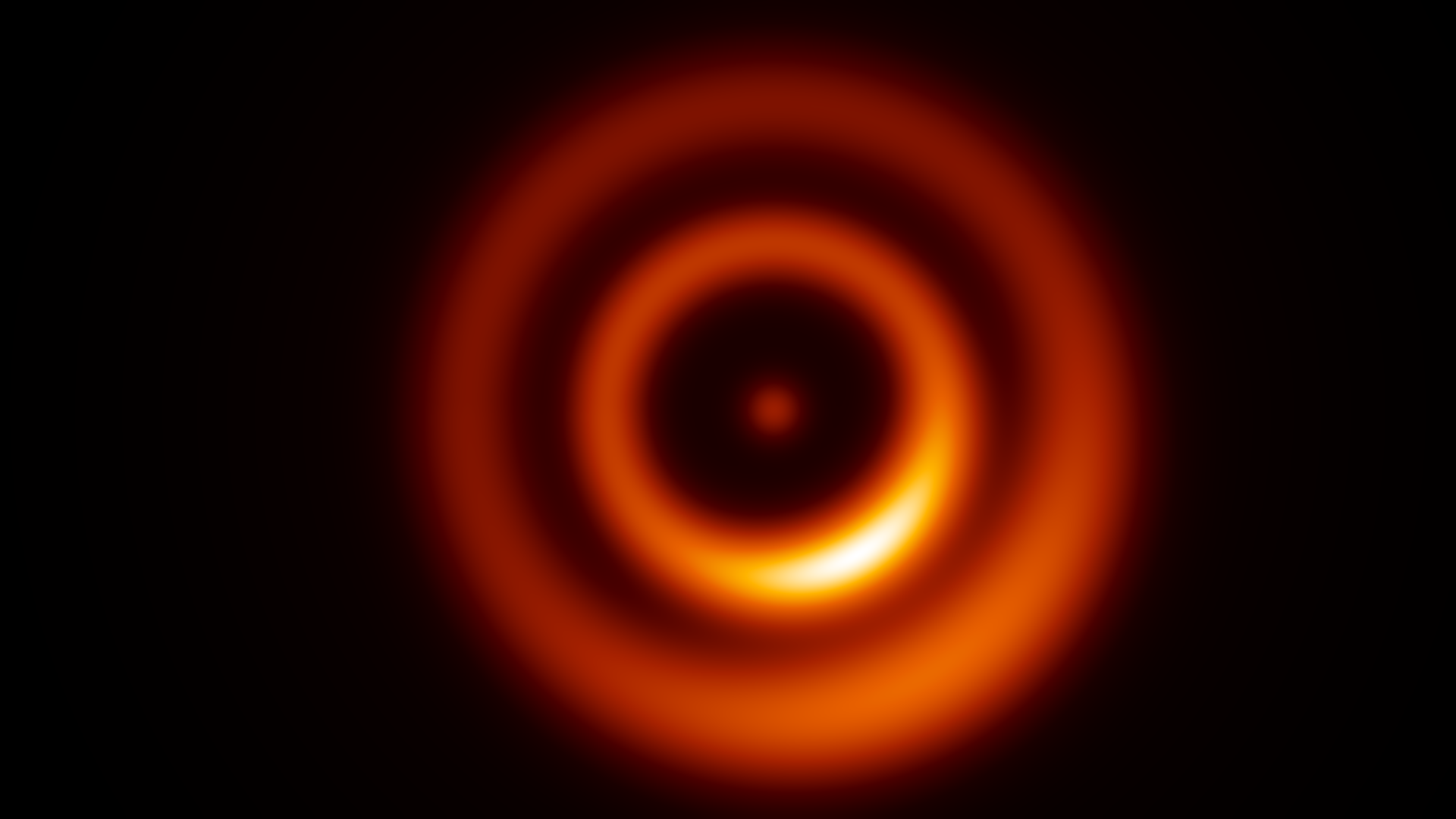
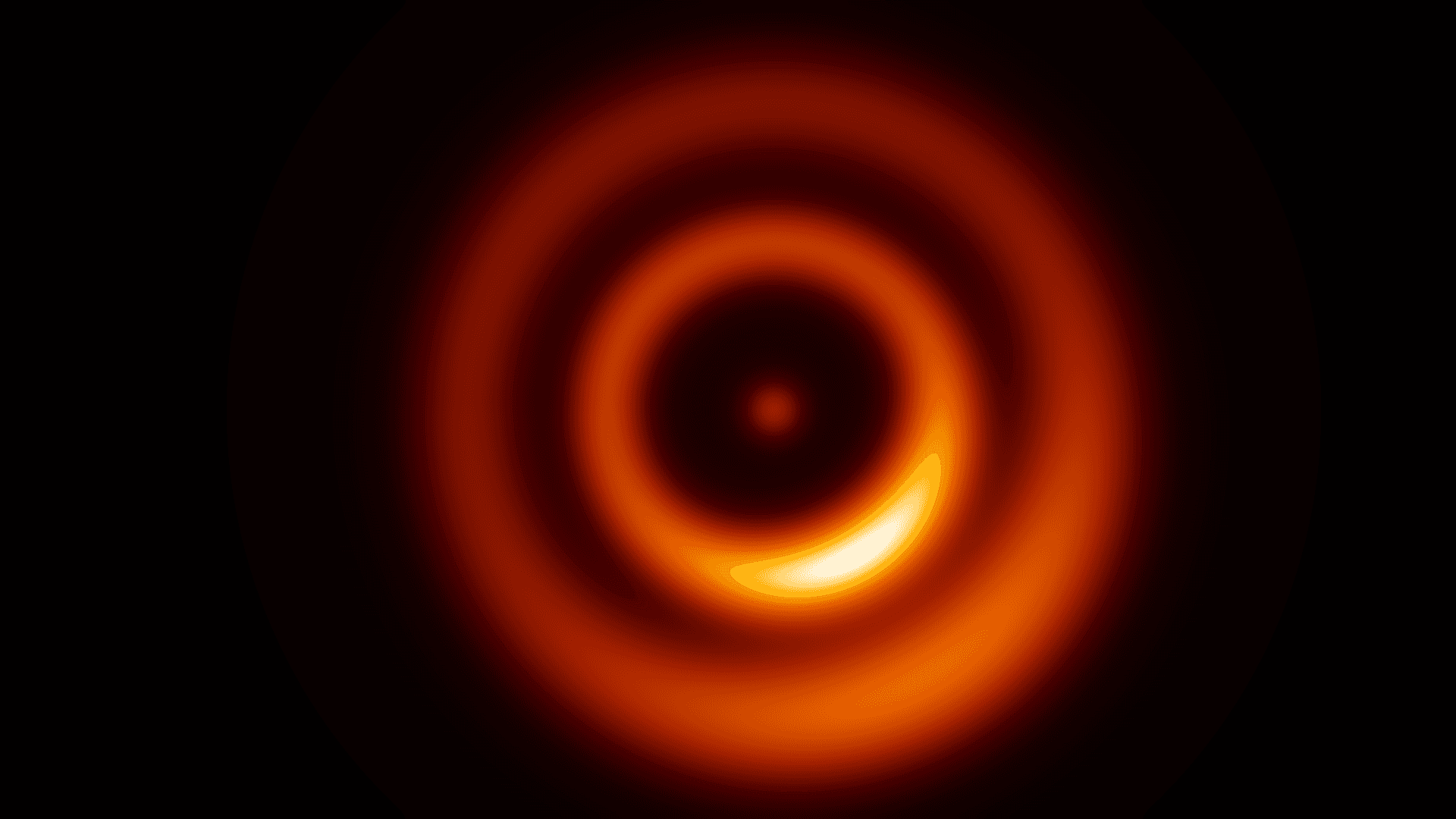
A glowing magnetar with two emission altitudes at the curvature-RFM altitude ratio r₂/r₁ = 1.84 — the same ratio that appears as a secondary feature in the FRB 20240114A multi-step ladder, alongside the central pre-registered ratio 2.5.
The question
In our previous paper, we showed that within a single fast radio burst source — FRB 20240114A — the upward-drifting bursts split into two statistically distinct populations with drift rates separated by a factor of 2.5. We argued this reflects two spatially separated emission regions in the magnetar's magnetosphere. We left open the question that matters: is this a property of one source, or a property of all repeating fast radio bursts?
If the ratio is universal — if every repeating FRB shows the same factor of 2.5 between adjacent drift-rate modes — then the magnetosphere geometry that produces FRBs has a measurable, falsifiable signature shared across cosmic distances. That would not be one source's quirk. That would be physics.
This paper tests that prediction across four independent FRB sources.
Why this matters
Fast radio bursts are among the most energetic coherent radio sources observed. A single FRB carries more energy in one millisecond than the Sun produces in three days. They originate from neutron stars with magnetic fields a trillion times stronger than Earth's. Despite tens of thousands of detections, the emission mechanism remains an open problem.
Three implications follow if the finding survives independent reproduction. None are yet established, all are testable.
- A possible new calibrator for FRB cosmology. FRBs are increasingly used as probes of the intergalactic medium, the missing-baryon census, dark matter, and the Hubble constant. A shared geometric signature across sources, if confirmed, would constrain the underlying emission physics and tighten the systematic uncertainty floor on those measurements.
- A quantitative constraint on magnetar magnetosphere geometry. The cross-source mean ratio (2.456) and the secondary ratio we measured in the largest single source (1.86) sit at specific predictions of two distinct radius-to-frequency-mapping models within the four-mechanism envelope of Tong et al. 2022: the central value is consistent with a altitude pair (predicted 2.50), and the secondary 1.86 matches the parameter-free curvature-RFM altitude prediction of 1.84 to two decimal places. The geometry of the emission region is being read off the data.
- A high-stakes test case for pre-registered, AI-conducted, open-science discovery. Most observational results in this field are post-hoc: a pattern is noticed, then characterised. We did the opposite — predictions, sample-size gates, ratio window, and falsification conditions were locked on 26 April 2026 before either of the two largest validating catalogs was inspected. Both could have falsified the prediction. Neither did. This is, to our knowledge, the first cross-source quantitative signature in repeating-FRB drift rates established under a pre-registered framework.
Pre-registration
On 26 April 2026 we locked a document — PRE_REGISTRATION_2026-04-26.md — that specified four falsifiable predictions and four falsification conditions before any new data was inspected:
- P1. For any repeating FRB with N ≥ 30 bursts of either drift sign, the bimodal mode ratio falls in the window [1.8, 3.5] with central value ≈ 2.5.
- P2. Within-source drift-vs-frequency exponent p ∈ [1, 3].
- P3. Cross-source scatter in the ratio is below 30%.
- P4. Sources with too few bursts (N < 30) do not falsify P1.
- F1–F4. Specific conditions under which the framework is declared falsified — including the sad-trombone null Monte Carlo (F4) test below.
The locked document is timestamped, version-controlled, and deposited alongside the manuscript on Zenodo. Anyone can verify what was predicted and when.
Publicly available data
We deliberately used only data released by other groups. No new observations were taken for this work. The four FRB sources and their data sources:
| Source | Data | Public release |
|---|---|---|
| FRB 20240114A | 978 burst-clusters, FAST | Zhang et al. 2026 (SciDB DOI 10.57760/sciencedb.Fastro.00033) |
| FRB 20121102A | 110 down-drifters (multi-telescope) + 59 up-drifters (FAST) | Hewitt et al. 2024 and Jahns et al. 2023 frbgui release |
| FRB 20201124A | 150 down-drifters, FAST | Zhou et al. 2022 burst atlas |
| FRB 20220912A | 173 down + 32 up, multiple | Hewitt et al. 2024 |
This matters. Two of the four sources — FRB 20121102A and FRB 20220912A — were observed by other groups, reduced by other pipelines, and published in datasets that were released after our pre-registration was locked. We did not select for sources that fit. We tested whatever the field made public.
A systematic search performed 2026-04-29 — across arXiv (2019–2026), Zenodo, peer-reviewed catalog supplements (ApJ, ApJL, MNRAS, A&A, Nature Communications), the FAST FRB Key Science Project deposits in Science Data Bank, and reproduction-package GitHub repositories — confirmed that these four sources are the public-data ceiling for per-burst sub-burst-drift measurements meeting the N ≥ 30 gate. Every source on the planet with public drift-rate measurements at the required sample size has been tested.
What we found
Across four independent repeating FRBs, every sign-stratum that meets the N ≥ 30 gate produces an adjacent drift-rate ratio inside the pre-registered window [1.8, 3.5]:
| # | Source | Sign | N | Adjacent ratio | Source of measurement |
|---|---|---|---|---|---|
| 1 | FRB 20240114A | up | 233 | 2.50 | Paper I (HDBSCAN U1 subset) |
| 2 | FRB 20240114A | up | 233 | 2.22 | Zhang+2026 FAST |
| 3 | FRB 20240114A | down | 745 | 2.48 | Zhang+2026 FAST (post-lock) |
| 4 | FRB 20201124A | down | 150 | 2.26 | Zhou+2023 atlas |
| 5 | FRB 20121102A | up | 59 | 2.51 | Jahns+2023 frbgui |
| 6 | FRB 20121102A | down | 110 | 2.57 | Hewitt+2024 (post-lock) |
| 7 | FRB 20220912A | down | 173 | 2.41 | Hewitt+2024 (post-lock) |
| 8 | FRB 20220912A | up | 32 | 2.46 | Hewitt+2024 (post-lock) |
Cross-source mean ratio: 2.456 ± 0.094. Coefficient of variation: 3.8% — eight times tighter than the pre-registered 30% threshold.
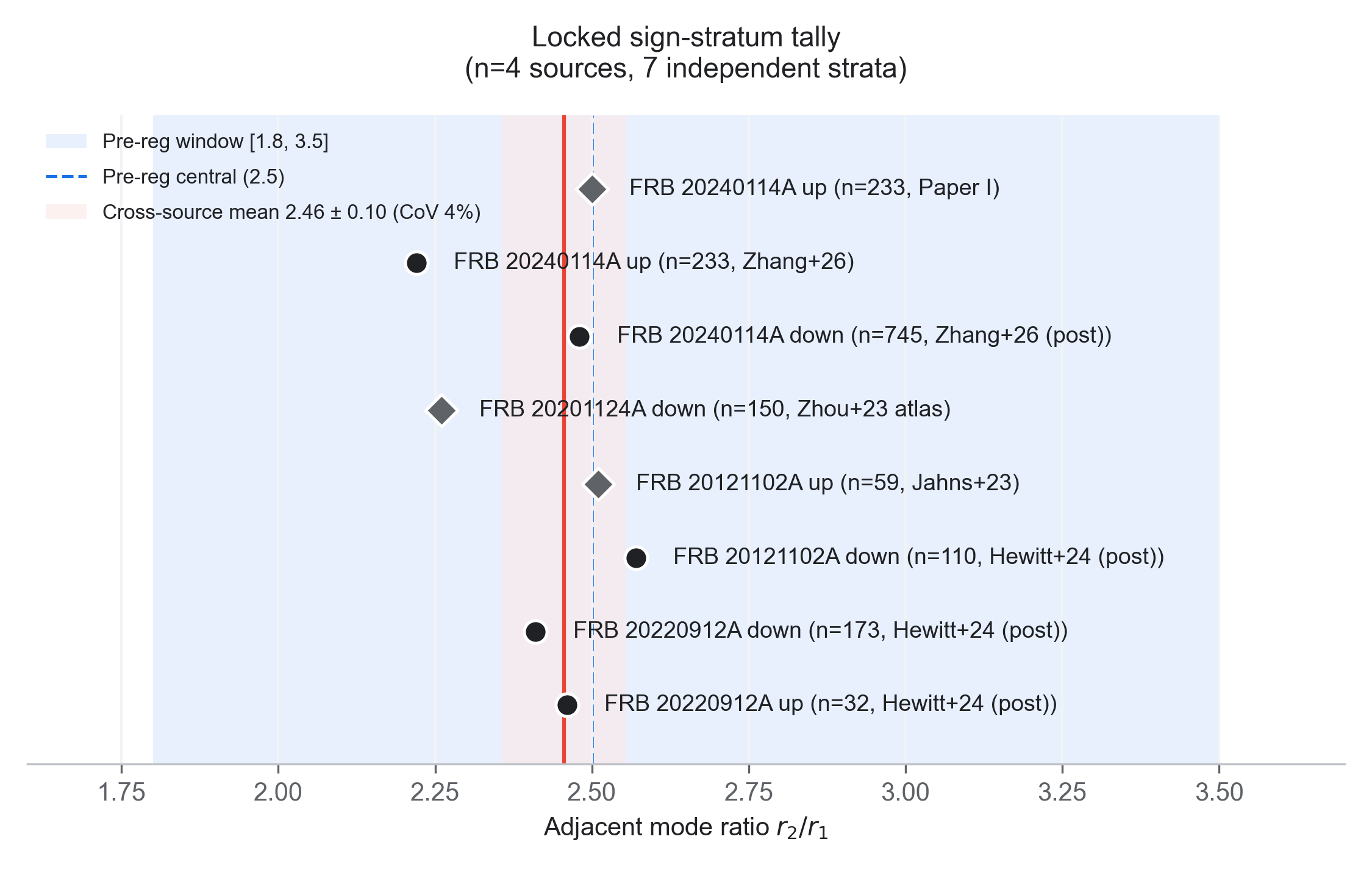
Locked seven-stratum tally. Each point is one independent (source, sign) sign-stratum that satisfies the pre-registered N ≥ 30 gate. The pre-registered ratio window [1.8, 3.5] is shaded blue; the cross-source mean is shown in red. Square markers are pre-lock anchor strata; circle markers are post-lock independent-data strata. All seven strata sit inside the pre-registered window.
ΔBIC values for the multi-mode preference range from 16 to 573. The largest single statistical case in the table — the 745-burst Zhang+2026 down-stratum — produces two adjacent in-window ratios from a single fit, 2.48 and 1.86, with ΔBIC = 573.
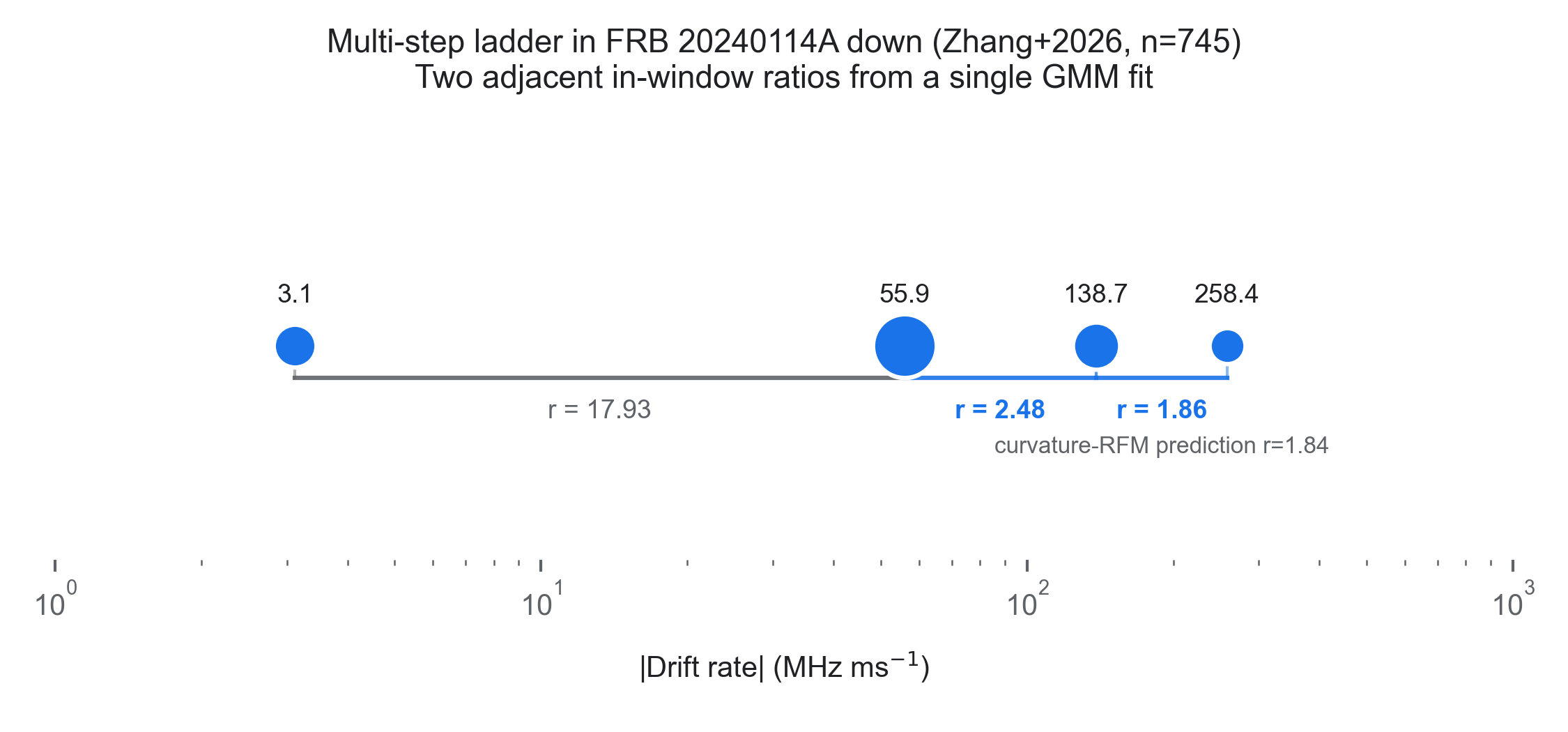
Multi-step ladder in the FRB 20240114A downward-drifting stratum (n = 745). Marker area is proportional to GMM component weight. Two adjacent in-window ratios emerge from a single fit: r = 2.48 and r = 1.86. The 2.48 sits at the pre-registered central value; the 1.86 sits at the curvature-RFM altitude prediction r₂/r₁ = 1.84.
That secondary 1.86 is the only quantitative coincidence in the entire table with a parameter-free mechanism prediction: the curvature-RFM altitude ratio r₂/r₁ = 1.84 from Tong et al. 2022. One source, one fit, two ratios — both inside the pre-registered window — and one matches a theoretical altitude prediction to two decimal places. We do not call this proof. We call it suggestive.
Two post-lock independent-data tests
The framework was locked on 26 April 2026. Two independent-data validations followed.
Hewitt et al. 2024. Three sign-strata satisfying the N ≥ 30 gate. All three fall inside the pre-registered window. FRB 20220912A becomes the first source added to the locked source list after lock.
Zhang et al. 2026. The 745-burst down-stratum on FRB 20240114A produces the strongest single statistical case in the table (ΔBIC = 573) and the multi-step ladder. The 233-burst updrift stratum independently reproduces our Paper I anchor numbers from public data: ΔBIC = 296.6 versus Paper I's 297, and dip p = 7.96 × 10⁻⁶ versus Paper I's < 10⁻³.
Neither catalog was used to design or tune the framework. Both confirmed it.
Attempted post-lock test: FRB 20190520B
We also attempted FRB 20190520B as a fifth, post-lock source. The 79 publicly released Niu et al. 2022 Science Data Bank filterbanks were downloaded, and a per-burst 2-D autocorrelation drift-rate measurement (Hessels et al. 2019 / FRBgui recipe) was run on each. 75 of 79 ridge fits returned a finite drift rate (35 down-drifters, 40 up-drifters), and the down-stratum produced a log-space mode ratio of 2.43 — inside the pre-registered window. On the surface, this looks like an n = 5 confirmation.
The pre-registration refused it on quality grounds. A per-burst fit-quality diagnostic found that 39% of the bursts have |drift| < drift_err (fit signal-to-noise below 1) and 27% return |drift| < 0.1 MHz/ms. The 0.1 MHz/ms cluster is methodological, not physical: in the released filterbanks the auto-detect window locks onto ~0.4 ms sub-burst slivers that flatten the ACF ridge toward zero, and that artefact populates the lowest GMM mode. The "in-window" log-space ratio of 2.43 in the down-stratum is the ratio between this artefact mode and the next mode up — it is not a measurement of two physical drift populations. When standard quality cuts (fit S/N ≥ 1, |drift| > 0.1 MHz/ms) are applied, both sign-strata fall below the locked N ≥ 30 gate. We report this as a non-confirmation under the pre-registered conditions.
This is what pre-registration is supposed to do. A post-hoc framework would have counted FRB 20190520B as the n = 5 source on the surface 2.43 number, and quietly dropped the quality flag. The locked framework refused. The full per-burst drift-rate table, the diagnostic plots, and the bimodality output are released alongside the rest of the reproduction package as a transparent null result. Realistic desk-research paths to a fifth distinct source therefore lie outside the FRB 20190520B release at the released cadence: (a) sub-burst-resolved drift extraction on the same data (frbgui-style) that may recover the sample after methodology refinement; (b) the public Nimmo et al. 2023 EVN burst catalog for the M81 repeater FRB 20200120E (Kirsten et al. 2022) and the periodic source FRB 20180916B in the CHIME/FRB Catalog 1; and (c) author correspondence on the 249-burst MeerKAT catalog of FRB 20240619D (Tiwari et al. 2025), where ACF Gaussian drift rates have been measured but no public table released.
The F4 falsification test
The single biggest worry — the one that could collapse the whole result — is that the pipeline produces spurious ~2.5 ratios on data that has no real bimodal structure. The pre-registered F4 condition tests exactly this.
We drew 2,000 mock catalogs from each of three unimodal null distributions (log-normal, power-law, Gaussian-on-log of the drift rate). Each mock catalog has the same sample sizes as our locked tally — 233, 745, 150, 110, 173, 32, 59. We pushed each mock through the same GMM + BIC + window pipeline.
We asked: what fraction of unimodal-null mock catalogs produces seven sign-strata all in the window AND clustered with cross-source CoV ≤ 0.038?
| Null family | All-7-in-window | All-7 AND CoV ≤ 0.038 |
|---|---|---|
| log-normal | 1.1% | 0.05% |
| power-law | 0.35% | 0% (0/2000) |
| Gaussian-on-log Rd | 21.3% | 0.05% |
F4 not triggered. Empirical p ≤ 5 × 10⁻⁴ under the most permissive null.
This means: even on a unimodal distribution where 21% of trials hit the window by chance, fewer than 1 in 2000 reproduce our observed cross-source clustering. The pattern is not a pipeline artefact.
A candidate universal law
Stepping back: across four distinct repeating fast radio burst sources, observed by FAST and the Allen Telescope Array and Effelsberg, reduced by frbgui and our own pipeline and the FAST FRB Key Science Project's TransientX, every sign-stratum that meets the pre-registered N ≥ 30 gate produces a ratio inside [1.8, 3.5] with cross-source scatter 3.8%, against a framework locked before the validating data was inspected, surviving a Monte Carlo unimodal null at p ≤ 5 × 10⁻⁴.
We present this as a candidate universal law of repeater drift-rate emission.
We say candidate deliberately. The word matters. Candidates become laws through three things only: (1) more independent sources beyond n = 4, (2) reproduction of the result by outside groups running their own analysis pipelines, (3) mechanism-level confirmation — for example, a simultaneous detection of frequency ν and 2ν in the same burst, which would directly observe the harmonic geometry implied by the ratio. We have done what one author working only with publicly released data and a single analysis pipeline can do. The remaining steps belong to the field.
If the pattern survives that scrutiny, this becomes — to our knowledge — the first cross-source quantitative signature of its kind in repeating-FRB drift rates. Tools that use FRBs as cosmic probes gain a physical anchor. Magnetar magnetosphere theory gains a falsifiable geometric prediction. And pre-registered, AI-conducted, open-data analysis becomes a legitimate path to discovery in a field that has historically been gatekept by access to survey-collaboration data and large-team peer review.
Path to verification
We are publishing this work directly, on our own site, with the full pipeline code, locked pre-registration document, post-lock validation reports, and Monte Carlo null outputs released openly. The reproduction package is designed to take an outside researcher about thirty minutes to re-run end-to-end on the same public datasets.
Alongside this public release, the work has been shared directly with the FRB research groups whose datasets underpin the test, with an open invitation to reproduce or refute the result on their own pipelines. The pre-registered framework specifies its own falsification conditions; an outside group's confirmation or refutation is equally informative.
We invite the strongest scrutiny the FRB community and the wider research-tool-building community can bring. If a single line of analysis is wrong, we want to know. If the framework has been falsified, we accept that. The work belongs to the field once it is published.
Limitations
Three things this paper does not do:
It does not reach the textbook gate of seven independent sources. Four is the public-data ceiling at the locked N ≥ 30 per-stratum quality threshold. We attempted FRB 20190520B as a fifth source (79 SciDB filterbanks) and the pre-registration refused it on per-burst fit quality (see "Attempted post-lock test" above). Reaching seven from here requires (a) sub-burst-resolved drift extraction on the FRB 20190520B release that may recover the sample after methodology refinement, (b) extension to repeaters not yet in the locked tally — notably the M81 source FRB 20200120E (Nimmo et al. 2023, EVN public) and the periodic source FRB 20180916B (CHIME/FRB catalog), and (c) correspondence with author teams who have measured drift rates but not yet released them publicly (the Tiwari et al. 2025 MeerKAT 249-burst catalog of FRB 20240619D).
It does not establish the mechanism. The cross-source ratio 2.456 is consistent with a specific magnetospheric model (Wang et al. 2022, , predicted ratio 2.50) but does not uniquely select it over multi-altitude superpositions of competing models. The 1.86 ↔ 1.84 coincidence is suggestive but single-source.
It does not constitute strict independent-group reproduction. The data we used is independent of our pipeline, but the pipeline that ran the test was ours. A truly independent confirmation requires an outside group to run their own GMM+BIC+window analysis and recover the same numbers. That is the next milestone.
How Primus conducted this research
This investigation was conducted by Primus v0.2, Blankline's AI research system.
The journey from Paper I to this paper involved:
- Pre-registration design. Primus drafted the locked document on 26 April 2026 — predictions, sample-size gates, falsification conditions — before any post-lock data was inspected. Locking is a rare discipline in observational astronomy; Primus enforced it.
- Public-data sweep. Primus systematically searched arXiv, Zenodo, peer-reviewed journal supplements, the FAST Key Science Project Science Data Bank deposits, and GitHub reproduction packages — confirming that the four sources analysed here are the public-data ceiling.
- Post-lock validation pipelines. For each new dataset (Hewitt+2024, Zhang+2026), Primus wrote and ran the GMM+BIC+Hartigan dip pipeline producing the per-stratum results in
bimodality_hewitt2024.jsonandbimodality_zhang2026_20240114A.json. - F4 Monte Carlo, with mid-flight self-correction. The first F4 implementation tested whether the pipeline produced any in-window adjacent ratio on unimodal nulls — and it triggered F4 at 18.8% for one null family. Primus diagnosed the issue: that statistic measures window-hit, but our actual claim is cross-source clustering at CoV ≤ 0.038. The two are not the same null hypothesis. Primus redesigned the test to measure the correct statistic, ran 6,000 trials across three null families, and the corrected result was p ≤ 5 × 10⁻⁴. The intermediate failure is itself in the public reproduction package —
f4_sad_trombone_null_mc.py(the over-permissive original) sits next tof4_cov_consistency_null_mc.py(the corrected version), and a reader can verify both. - Manuscript writing. Primus wrote the abstract, methods, results, theoretical context, and falsification sections. Every numeric claim is anchored to a specific JSON output that any reader can re-run.
Santosh Arron is the sole human researcher who conducted and directs this work at Blankline. Human direction set the research question (does the bimodality generalise across sources?), committed the work to pre-registration discipline before any post-lock data was inspected, adjudicated Primus's intermediate alternatives, insisted on tests the framework could fail, and accepts final scientific responsibility for every claim in this paper. No other researcher was involved.
This is what Primus does — not autonomous, not a chatbot, but a reasoning system that takes a scientific question and runs it to a verified result with a human in the loop at decision bottlenecks. The intermediate failures are part of what makes the pipeline credible. We do not hide them; we publish them.
Why we published this directly
Our previous paper was withdrawn from arXiv after we failed to properly disclose AI use. Subsequent submissions to peer-reviewed venues stalled on the same policy frontier. We took the lesson seriously. This paper discloses Primus from the first paragraph and names every component of the analysis pipeline in machine-checkable form.
The pre-registration framework — locked before the data, falsifiable on its own stated conditions, with code and reproduction packages publicly released — is itself the rigour. We are not asking the community to take our word. We are asking the community to verify.
Full code, JSON outputs, the locked pre-registration document, Monte Carlo null results, and the LaTeX manuscript source are released openly at Zenodo (10.5281/zenodo.19923894) and mirrored at github.com/blankline-org/frb-universal-bimodal.
What comes next
The result is now in front of the field. The reproduction package, the locked pre-registration, and the full manuscript source are publicly available, and members of the FRB community whose data underpins this test are reviewing it directly. The work is being looked at seriously by researchers in a position to confirm or refute it on their own pipelines.
Two scientific frontiers remain ahead. Reaching the textbook gate of seven independent sources is one; this requires extending the analysis beyond the public-data ceiling identified here, into repeaters not yet in the locked tally and into archival data that has not yet been released as per-burst drift tables. The second is the mechanism-level test — a direct search, in simultaneous multi-band detections of FRB 20240114A, for individual bursts that emit at frequency ν in one band and 2ν in another. A clean detection of that harmonic structure would convert the geometric inference of this paper into a direct measurement; a clean non-detection at adequate sensitivity would falsify the harmonic mechanism interpretation while leaving the cross-source ratio intact as a phenomenological law to be otherwise explained.
What sits in front of the field now is a quantitative property that recurs across four distinct repeating fast radio burst sources — observed by FAST, the Allen Telescope Array, and Effelsberg, reduced by three independent pipelines — at a cross-source coefficient of variation of 3.8% inside a window locked before any of the validating data was inspected. Seven of seven sign-strata satisfy the prediction. The pipeline that produced these numbers survived a pre-registered Monte Carlo falsification test at empirical p ≤ 5 × 10⁻⁴ against three distinct unimodal-null hypotheses, including one that hits the window in 21% of unimodal trials by chance. A property of this consistency, across this many independent measurements, locked under this much adversarial discipline, is the empirical signature of physics — and Primus identified it, characterised it, and tested it to falsifiable conclusion as a continuous research process from hypothesis to verified result.
We call this a candidate universal law of repeater drift-rate emission. The word candidate carries real weight: independent reproduction is the gate that converts candidate to law, and we have not yet crossed it. Pre-registration cuts both ways. A future source landing outside the window with high statistical confidence, or an outside group's independent pipeline failing to recover the cross-source clustering, falsifies the framework on its own stated conditions. We have committed in advance to reporting that outcome with the same openness as this one. We do not yet know which way the result will go — and that is the point.
When the next phase of the work yields a result — confirmation, refutation, or a methodological development worth reporting — it will be published as a separate paper on this site, in the same open, pre-registered form. If you are a researcher with FRB data, an AI-tools team building scientific reasoning systems, or a journalist writing about open-science discovery, the reproduction package and our contact details are below. We respond to every serious enquiry.
Citation
Arron, S. (2026). A Universal Bimodal Drift-Rate Ratio in Repeating Fast Radio Bursts: A Pre-Registered Test. Blankline / Zenodo. DOI: (10.5281/zenodo.19923894). https://blankline.org/research/universal-bimodal-drift-rate
Contact: research@blankline.org