
Dropstone is an agent whose version number tracks the integration, not the model weights. Each cycle we evaluate the strongest open-weight models available and ship whichever wins. In 1.7 the Fast tier moves to DeepSeek V4 Flash 0731, the Pro tier moves to GLM-5.2, and the Heavy tier moves to Kimi K3. All three tiers changed.
All three moves are upward. GLM-5.2 was 1.6's Heavy tier and is now the Pro default, which means the model that was previously gated to paid plans is now available on every plan including free. Kimi K3 takes Heavy.
The Fast move is the largest single jump in the release. DeepSeek V4 Flash 0731 shares its architecture and its price with the V4 Flash we shipped at 1.6 — 284B total, 13B active, same rate card — but it is a retrained model rather than a point revision, and it scores 50 on the Artificial Analysis Intelligence Index against 40 for its predecessor. Ten points is a larger move than anything else in this release, Heavy included.
Three consequences, none of them rhetorical:
- Fast is now 6 points ahead of DeepSeek V4 Pro, a model one tier above it in its own family, while activating 13B parameters per token.
- Fast is 1 point behind Pro (GLM-5.2, 51). Both are free on every plan, so the capability floor of a free Dropstone account moved to within a point of its ceiling.
- Kimi K3 (57), GLM-5.2 (51) and V4 Flash 0731 (50) are the top three open-weight models on the index. All three are Dropstone tiers.
The result worth leading with: on the Artificial Analysis Intelligence Index, Kimi K3 scores 57.1. That is the highest of any open-weight model, and it is the first open model to clear GPT-5.5 at 54.8. It does not catch the closed frontier, which sits above it at 60.7 (Claude Opus 5), 59.9 (Claude Fable 5), and 58.9 (GPT-5.6 Sol). The gap to the leading closed model is 3.6 points. At 1.6 the equivalent gap was 8.8 points. It has narrowed by more than half in one cycle. It has not closed, and we are not going to describe it as though it has.
There is one measure where the open models do win outright. On the Frontend Code Arena, where developers compare two anonymous outputs and pick the better one without knowing which model produced either, Kimi K3 ranked first at 1679 points, ahead of Claude Fable 5 at 1631 and GPT-5.6 Sol at 1618, across 1,757 votes. GLM-5.2, our Pro tier, placed fourth at 1587, ahead of Claude Opus 4.8. K3 took six of the seven frontend categories. This is the first time an open-weight model has led that board. It is also a narrower result than it sounds, for a reason we state up front rather than in a footnote: Claude Opus 5 released on 24 July, after the ranking was published, and its Frontend Code score is not out yet. K3 leads the field as published, not the field as it stands today.
This report also changes the benchmark we lead with, and we want that change on the record rather than buried. 1.6 led with SWE-bench Pro, vendor-reported. Kimi K3 publishes no SWE-bench Pro score, and the coding numbers it does publish run on Moonshot's own harness, which makes them incomparable to differently harnessed competitors. Rather than chart a number we cannot defend, we moved to an independently measured index that covers every model and every tier. We think this is a stronger evidence base than 1.6 had, and we explain why below.
Our evaluation discipline is unchanged: every number here is independently measured, labeled as such, shown on a full axis, and we would rather under-claim than overclaim.
What Dropstone is
Dropstone is not a foundation model. It is a runtime that turns an open-weight model into an agent you can leave running without worrying. It began as a coding agent and is now a general one: the same loop that fixes a failing test also researches a question, drives tools and external APIs, writes and edits documents, and carries out long multi-step tasks that never open a source file. The runtime owns the agent loop, an approval gate before any state-changing action, a US-hosted inference path, credit-based pricing, and the evaluation cycle that decides each generation. The model underneath is a component we swap. "Dropstone 1.7" names the generation that, at release, composes the three models above.
The reason to version the runtime rather than the weights is practical: when a better open model lands, we re-baseline and ship it, and you do not re-platform. 1.7 is the clearest illustration of that we have shipped. Two of three tiers changed model, and nothing about the agent loop, the approval gate, or the safety boundary changed with them.
Choosing the models
For each tier we ask the same question: which open-weight model gives the most agentic capability per dollar of US-hosted inference, without giving up the runtime's caching and safety discipline. The cycle that produced 1.7 returned three answers, two of them different from last cycle.
Heavy runs Kimi K3. It is the highest-scoring open-weight model on every independent measure we have, and the first open model to pass a flagship closed model on the aggregate index. It is a 2.8 trillion parameter sparse mixture-of-experts model activating 16 of 896 experts per token, with a 1M-token context and native image input. It is the subject of the next section.
Pro runs GLM-5.2. This was 1.6's Heavy. Promoting it to Pro is the part of this release most users will feel, because Pro is available on every plan and Heavy is not. Z.ai's 744B mixture-of-experts model, roughly 40B active per token, MIT licensed, 1M context. Moving it down a tier is not a demotion of the model; it is a statement that what counted as our top tier six weeks ago is now our default.
Fast runs DeepSeek V4 Flash 0731. It carries latency-sensitive work. We re-evaluated it against GLM-4.7-Flash and Qwen3.6-35B-A3B and kept the DeepSeek line, then took the 0731 retrain when it landed on 31 July 2026. Architecture and price are identical to the model it replaces — 284B total, 13B active, 1M context, text-only, 0.28 per 1M on DeepSeek's own API — so this is a capability gain at unchanged cost, which is rarer than a capability gain.
Artificial Analysis measures the retrain at 50 on the Intelligence Index against 40 before it, and places it on their Pareto frontier for Intelligence vs Cost per Task, roughly 60% below GPT-5.6 Luna at a score one point behind it. DeepSeek's ~98% cache-hit discount does much of that work, and our prefix caching is what realises it: see §Caching.
How we evaluate, and why the axis changed
The protocol is meant to be hard to argue with rather than flattering. One part of it changed this cycle, and the change is worth explaining carefully because switching benchmarks between releases is exactly the move a dishonest report would make to manufacture a win.
1.6 led with SWE-bench Pro. 1.7 cannot. Moonshot published no SWE-bench Pro result for Kimi K3. The coding numbers it did publish, including Terminal-Bench 88.3, FrontierSWE 81.2, DeepSWE 67.5, and ProgramBench 77.8, were produced on Moonshot's own KimiCode harness. When one model runs on its vendor's harness and another runs on Claude Code or Codex, the difference between the scores measures the two systems, not the two models. Charting those numbers against differently harnessed competitors would be benchmaxxing, and it is the specific failure this chart set exists to avoid. So we do not chart them anywhere, and we do not cite them as evidence of anything in this report.
We moved to the Artificial Analysis Intelligence Index. This is not a weaker substitute. On three counts it is stronger evidence than 1.6 had:
- It is independently measured. 1.6's SWE-bench Pro figures were all vendor-reported. These are not.
- It is measured uniformly across every model we compare against, so there is no source asymmetry to disclose.
- It covers all three of our tiers. 1.6 could not place Pro or Fast on its hero chart at all, because neither had a usable SWE-bench Pro score. For the first time we can show the whole cascade on one axis.
We also report GDPval-AA v2 and AA-Briefcase, both independently measured, as secondary agentic measures.
What we give up by switching. The 1.7 numbers are not continuous with the 1.6 numbers. A reader cannot compare GLM-5.2's 62.1 on SWE-bench Pro in the last report to Kimi K3's 57.1 here; they are different scales measuring different things. Where we compare across releases in this report, we do it by measuring both models on the current index, never by comparing a 1.6 figure to a 1.7 figure. That is the only honest way to run an axis change, and it costs us the simple year-over-year line a marketing report would want.
Axes are not truncated and labels are dual. Ours run the full 0 to 100. Every Dropstone bar carries both the tier name and the underlying model.
What we found: Kimi K3 (Heavy)
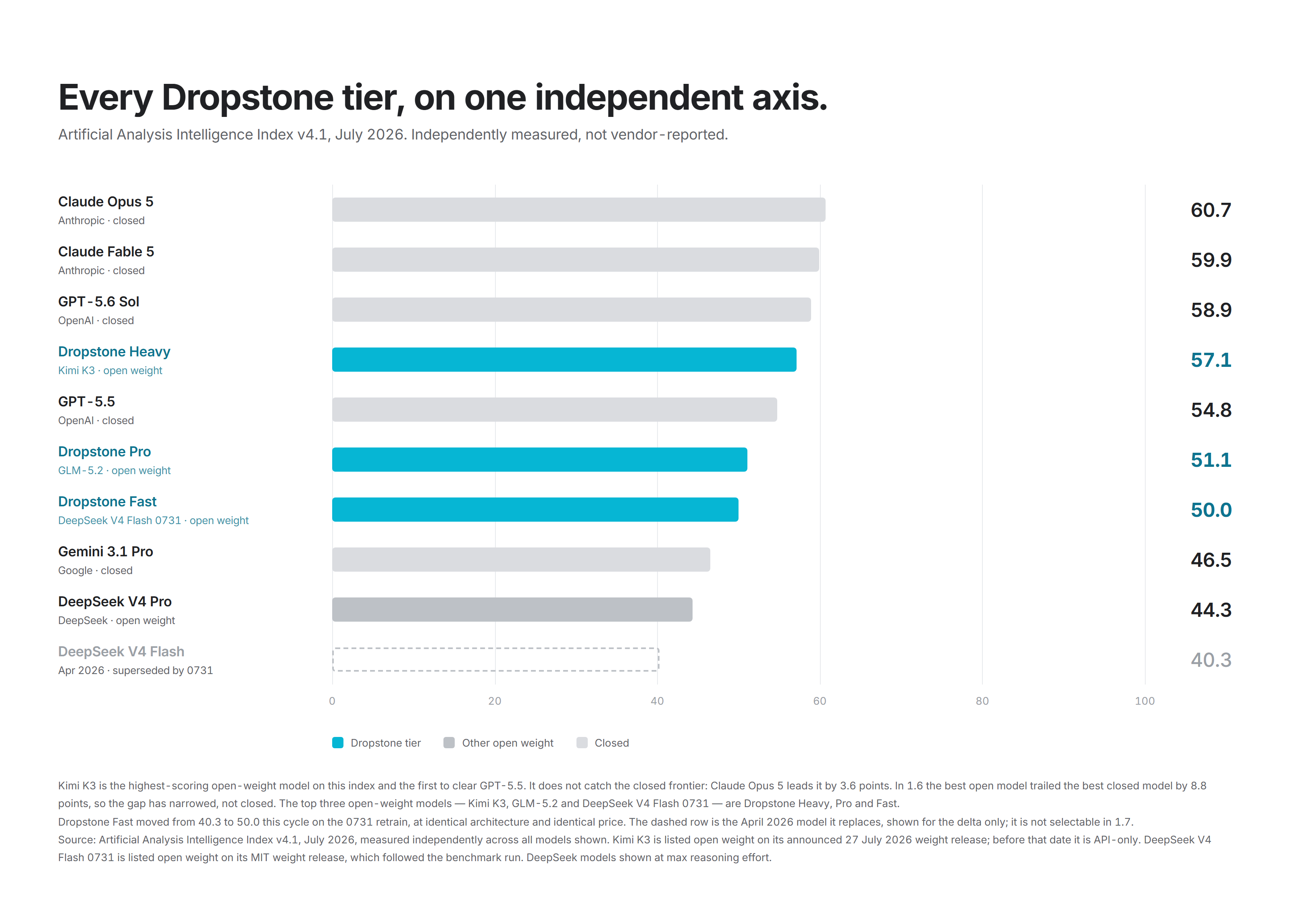
Artificial Analysis Intelligence Index: all three Dropstone tiers against the closed frontier. Independently measured, full axis.
| Model | Index | Class |
|---|---|---|
| Claude Opus 5 | 60.7 | closed |
| Claude Fable 5 | 59.9 | closed |
| GPT-5.6 Sol | 58.9 | closed |
| Kimi K3 (Dropstone Heavy) | 57.1 | open weight |
| GPT-5.5 | 54.8 | closed |
| GLM-5.2 (Dropstone Pro) | 51.1 | open weight |
| DeepSeek V4 Flash 0731 (Dropstone Fast) | 50.0 | open weight |
| Gemini 3.1 Pro | 46.5 | closed |
| DeepSeek V4 Pro | 44.3 | open weight |
| DeepSeek V4 Flash (Apr 2026, superseded) | 40.3 | open weight |
We would state the takeaways as exactly five:
- Kimi K3 is the highest-scoring open-weight model on this index.
- It is the first open model to clear a flagship closed model, passing GPT-5.5 by 2.3 points.
- It is behind Claude Opus 5 by 3.6 points, Fable 5 by 2.8, and GPT-5.6 Sol by 1.8.
- The open-to-closed gap at the top narrowed from 8.8 points at 1.6 to 3.6 points at 1.7, measured on the same index at both dates.
- The top three open-weight models on the index are Kimi K3, GLM-5.2 and DeepSeek V4 Flash 0731 — Dropstone Heavy, Pro and Fast. We did not arrange the lineup to produce that sentence; the three models we independently selected on capability are the three that occupy those positions.
We do not soften the third point. Three closed models are still ahead of the best open model in the world, and anyone whose work concentrates in the hardest band should weigh that. What changed is the size of the premium. When the gap was eight or nine points, the frontier was a different class of tool. At 3.6 points it is a margin most workloads will not notice, and the ones that do are identifiable in advance.
Agentic measures
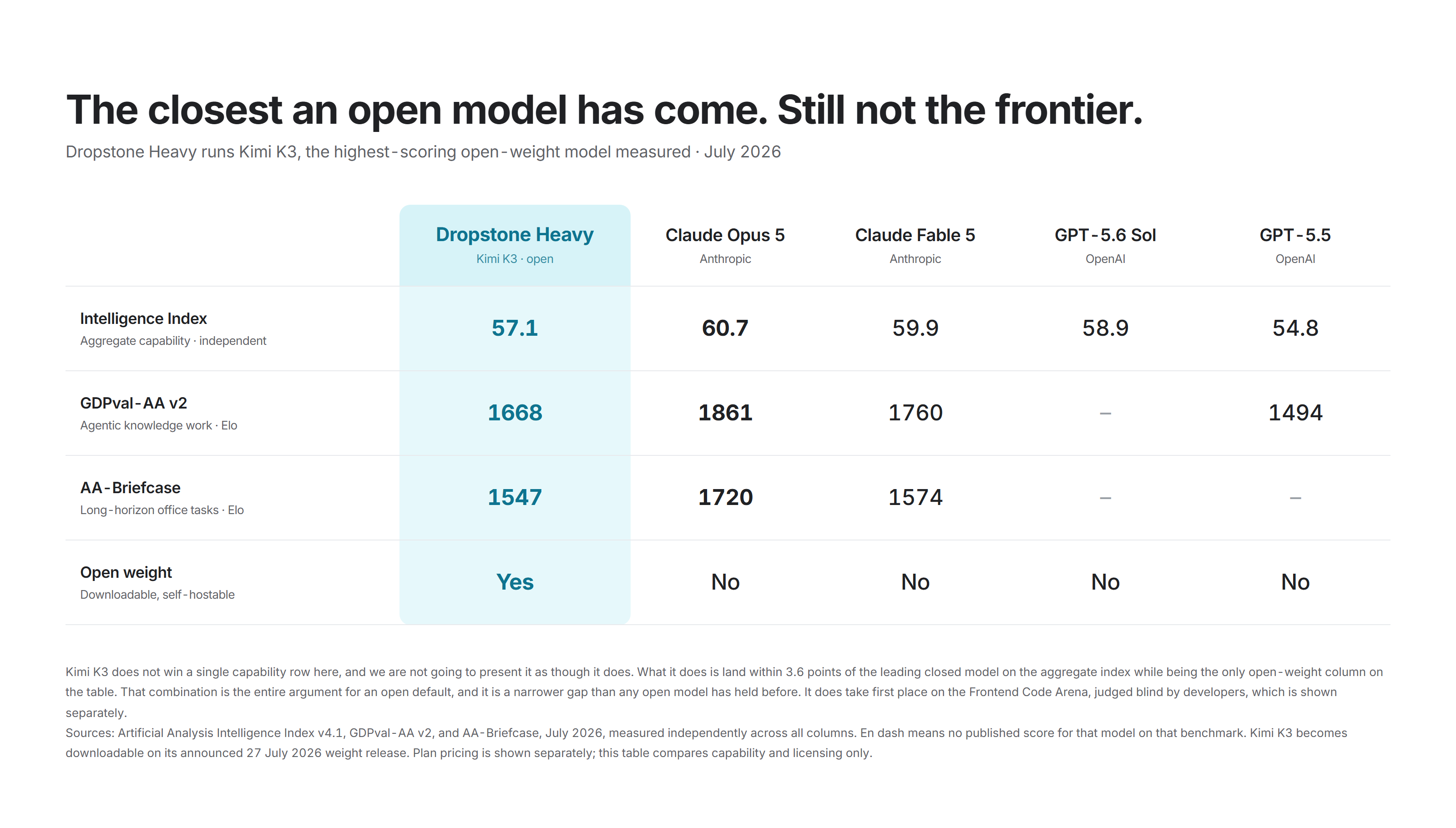
Dropstone Heavy against the closed frontier on capability and licensing
On GDPval-AA v2, which measures agentic knowledge work by Elo, Kimi K3 scores 1668. Claude Opus 5 leads at 1861 and Fable 5 at 1760; K3 sits ahead of Claude Opus 4.8 at 1600, GLM-5.2 at 1514, and GPT-5.5 at 1494. On AA-Briefcase, covering long-horizon office tasks, K3 scores 1547 against Opus 5's 1720 and Fable 5's 1574.
The pattern is consistent and worth naming plainly: on the aggregate index and on both agentic Elo measures, K3 loses to the current Claude frontier and beats everything else including the previous Claude flagship. Figure 2 shows it losing all three of those rows. We built the table that way on purpose.
One efficiency result is worth recording because it affects real cost rather than benchmark position: K3 completed the index using 132M output tokens against K2.6's 166M, a 21 percent reduction for a substantially higher score.
Frontend code, judged blind
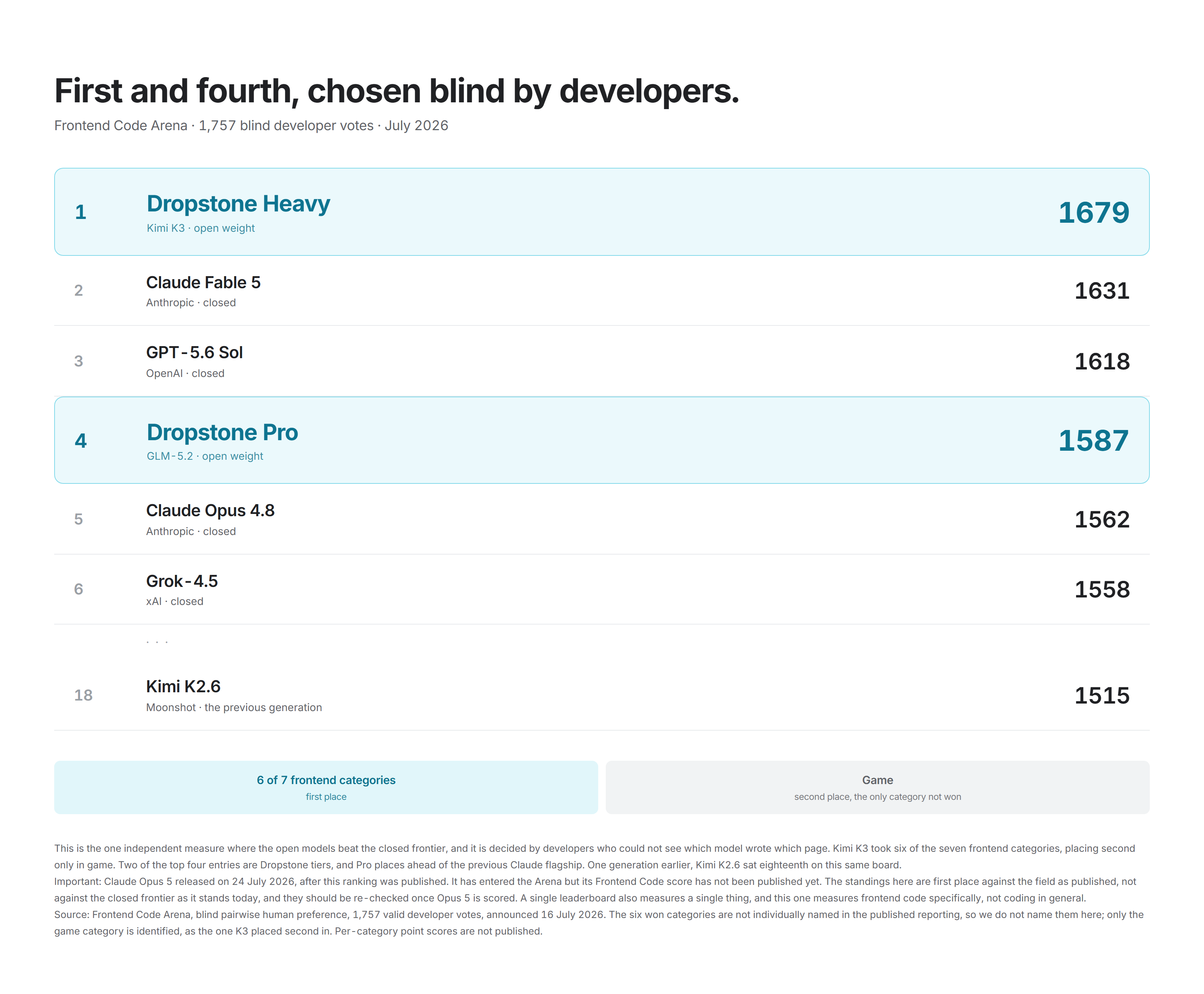
Frontend Code Arena standings, blind human preference
There is one independent measure where the open models come out ahead, and it is the one with humans in the loop rather than a scoring harness. On the Frontend Code Arena, developers are shown two anonymous outputs and pick the better one without being told which model produced either. Across 1,757 valid votes:
| Rank | Model | Score |
|---|---|---|
| 1 | Kimi K3 (Dropstone Heavy) | 1679 |
| 2 | Claude Fable 5 | 1631 |
| 3 | GPT-5.6 Sol | 1618 |
| 4 | GLM-5.2 (Dropstone Pro) | 1587 |
| 5 | Claude Opus 4.8 | 1562 |
| 6 | Grok-4.5 | 1558 |
| 18 | Kimi K2.6 | 1515 |
Three things are worth drawing out. K3 took six of the seven frontend categories, placing second only in game. Two of the top four entries are Dropstone tiers, and Pro sits ahead of the previous Claude flagship. And one generation earlier, Kimi K2.6 sat eighteenth on this same board, which is a seventeen-place move in a single release against a field that includes the current models from Anthropic, OpenAI, and xAI.
We attach two qualifications to this result and we do not want them read as small print. Claude Opus 5 is not on this board. It released on 24 July, after the ranking was published, has since entered the Arena, and its Frontend Code score has not been published. First place here means first against the field as published, and the standing should be re-checked once Opus 5 is scored. And a single leaderboard measures a single thing. This one measures frontend code. It is not evidence about coding in general, and we do not extend it to backend work, long-horizon agentic tasks, or the aggregate index, where the ordering above does not hold.
With those attached, this is still the strongest independent result in the release, and it is the only one decided by developers looking at output rather than by a benchmark harness.
Pro and Fast
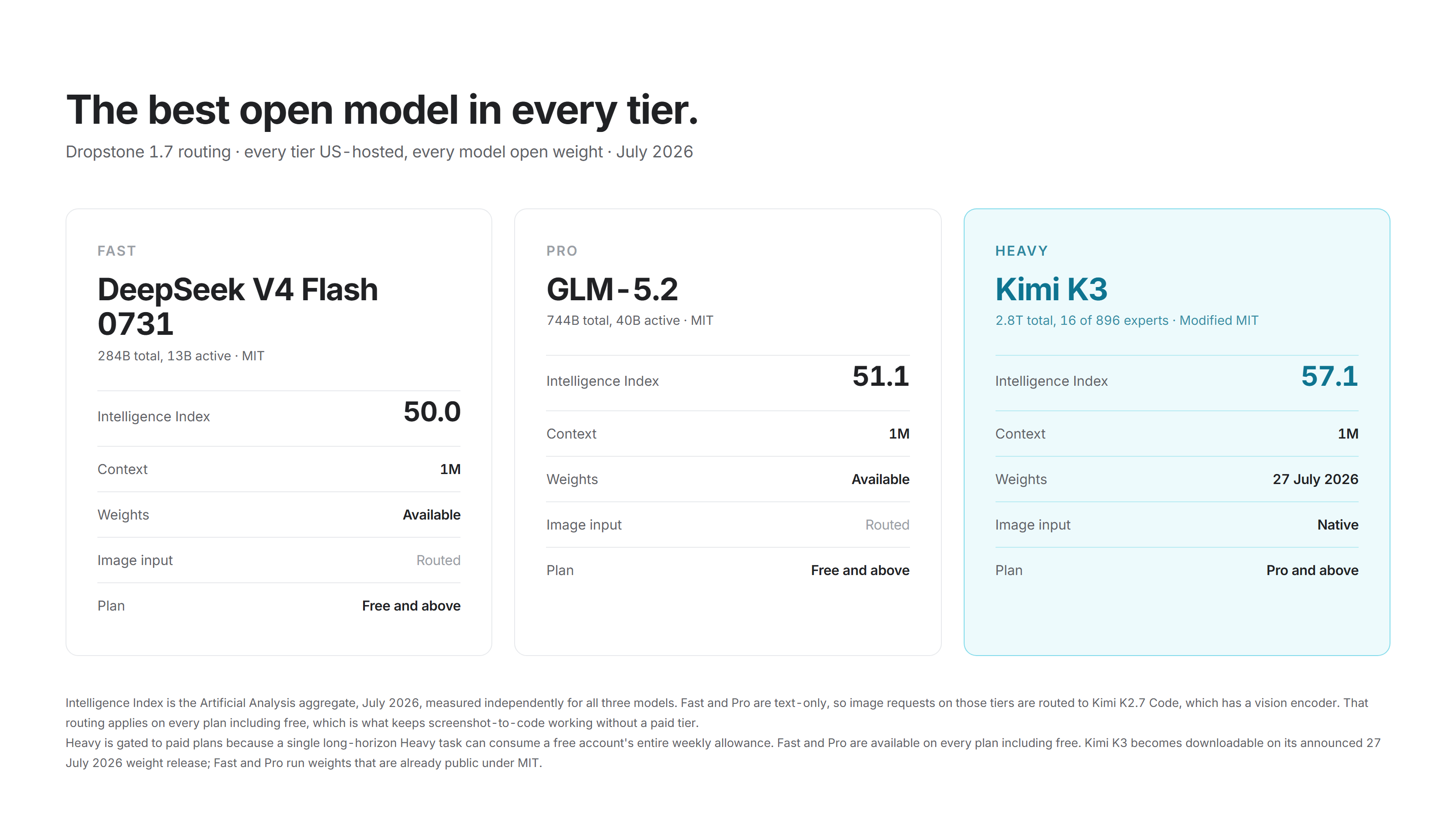
1.7 tier routing.
Pro (GLM-5.2) scores 51.1 on the aggregate index, above Gemini 3.1 Pro at 46.5 and below GPT-5.5 at 54.8. It does better than that rank suggests where humans judge the output directly: fourth on the Frontend Code Arena, ahead of Claude Opus 4.8. The relevant fact for users is not its rank but its tier. The model that was 1.6's paid-only Heavy tier is now the free-plan default, and we consider this the most substantive user-facing change in the release.
Fast (DeepSeek V4 Flash 0731) scores 50.0 at max reasoning effort, against 40.3 for the April 2026 model it replaces. That is the largest tier movement in the release, and it changes what Fast is for. At 1.6 we described Fast as a latency tier and made no capability claim for it. At 50.0 that description is no longer accurate: it sits 1.1 points below Pro, 3.5 above Gemini 3.1 Pro, and 5.7 above DeepSeek V4 Pro. On this index Fast is a capable tier that happens to also be the fastest, which is the opposite of the previous framing.
Its independently-measured component scores, from Artificial Analysis: GPQA Diamond 91, Terminal-Bench 2.1 79, AA-LCR 66, SciCode 50.
DeepSeek additionally published a set of agent-benchmark results with the retrain: Terminal-Bench 2.1 82.7, DeepSWE 54.4 against 7.3 for the preview, Toolathlon 70.3, Cybergym 76.7, NL2Repo 54.2, and a claim of beating V4 Pro Preview on all nine. We are not reporting those as measurements. They are vendor-stated, DeepSWE was run on DeepSeek's own harness which was not public at the time of writing, and no third party has reproduced them. The gap is visible in the one benchmark that appears on both lists: DeepSeek reports Terminal-Bench 2.1 at 82.7, Artificial Analysis measures 79. We use 79. Where a vendor number and an independent number disagree, the independent number is the number.
The vision path
Fast and Pro are both text-only. Heavy has native image input but is gated to paid plans. So image requests on every tier, on every plan including free, are routed to Kimi K2.7 Code, which has a vision encoder. Kimi K2.7 Code was 1.6's Pro tier and is no longer a tier you can select in 1.7, but it remains in the routing map for exactly this reason. This is what keeps screenshot-to-code working without a paid plan, and it is the one place where the model actually serving your request may not be the tier you chose. We would rather state that than let it be discovered.
What the numbers mean in practice
Benchmarks rank models; they do not tell you what a tier feels like on real work. This section translates the scores into expected behavior. The mapping follows from the measured numbers, not from cherry-picked transcripts.
Everyday coding and tool use. The densest part of the distribution, and the band where Heavy, GPT-5.6 Sol, and the Claude frontier cluster within a few points. In practice all of them resolve the common cases. A 3.6 point index gap does not surface as a visible quality difference on work of this kind, and Pro handles most of it without reaching for Heavy at all.
Long-horizon agentic work. Tasks that hold intent across many steps, which is where AA-Briefcase and GDPval are the better predictors. This is where the frontier premium is real: Opus 5's 1720 against K3's 1547 on Briefcase is a wider relative gap than the aggregate index suggests, and it shows up as the frontier drifting less over long sequences. If your work is dominated by multi-hour autonomous runs, that difference is the one to weigh.
Latency-sensitive work. Fast exists for this and is unchanged. Nothing in this release moves it.
A fair reading of the comparison set: Opus 5 and Fable 5 are the ceiling and lead on the hardest instances of every class; GPT-5.5 is the closed model K3 now passes on the aggregate index; and the open field below K3 is further back than it has been at any previous release. We show all of them so the gap above and the lead below are both visible at once.
Cost and access
Capability is half of the decision; cost of service is the other half.
We report cost at the plan level only. Dropstone plans are Free, $15 per month (Pro), and $75 per month (Max), against $20 and $100 for Claude Pro and Max 5x, $20 and $200 for ChatGPT Plus and Pro, and 60, and $200 for Cursor Pro, Pro+, and Ultra. We meter one weekly credit pool per account, shown as a single percentage with a reset countdown, rather than the rolling five-hour throttles competitors use. We do not promise a fixed number of turns per week, because turn cost varies by task and a fixed count is exactly the kind of contestable number this report avoids.
Two access facts about 1.7 that affect what you can use and when:
Heavy remains gated to paid plans. A single long-horizon Heavy task can consume a free account's entire weekly allowance. Gating it cleanly is better than letting a free user exhaust a week in one request.
Pro is now free-plan accessible and is a materially stronger model than it was. GLM-5.2 on the free tier is the practical headline of this release for most users.
Your data, and how we use it
Two properties keep the model's origin from being a buyer's problem, and a third describes a direction we are still early on.
Inference is US-hosted. Every request runs on US-hosted inference. The open-weight models' first-party APIs may be hosted outside the US; routing through Dropstone removes that from your compliance surface, and you configure nothing. This applies to Kimi K3 exactly as it applied to every model before it.
The agent cannot act without your approval. No file edit, shell command, or network call executes until you approve it. Because the safety boundary lives in the runtime, not the model, it holds identically whichever open model a generation runs. This is what let us change two of three tiers in this release without changing the security posture at all.
With consent, we learn from real sessions. Commercial and enterprise data is excluded entirely: never stored, never trained on, regardless of any setting. For consumer accounts, sessions help improve the open model by default, and you can turn that off at any time in settings. What we keep is text only, the task and the model's output and tool results, never your raw images. We are early. We do not yet claim a measured capability gain from this, and when we have one we will report it against the un-tuned model with the limitations attached.
Limitations
- We did not train the base models. Kimi K3, GLM-5.2, and DeepSeek V4 Flash 0731 are third-party open-weight models. We select, host, and integrate them; we cannot audit their training data or weights.
- We do not match the closed frontier. Opus 5, Fable 5, and GPT-5.6 Sol all lead Heavy on the aggregate index, and Opus 5 leads it by a wider relative margin on long-horizon agentic measures than the aggregate suggests.
- The Frontend Code Arena result predates Claude Opus 5. Opus 5 released after the ranking was published and has no Frontend Code score yet. Our first place is against the field as published. If Opus 5 scores above K3 when it is ranked, that result supersedes ours and we will say so. The result is also scoped to frontend code and should not be read as a general coding claim.
- We changed the primary benchmark axis this cycle. The 1.7 numbers are not continuous with 1.6's SWE-bench Pro numbers and should not be compared to them. We believe the new axis is better evidence, and we have stated the reasons, but a reader is entitled to treat a mid-stream axis change skeptically and we would rather flag that than not.
- Kimi K3's weights are not public as of this writing. Moonshot has announced release for 27 July 2026 under a Modified MIT license. Until that lands, K3 is an API-only model that we are describing as open weight on the strength of an announcement. If the date slips we will correct this report rather than quietly restate it.
- Kimi K3's own coding benchmarks are unusable for comparison. They run on Moonshot's harness. We exclude them entirely rather than discount them, which means our Heavy tier has no directly comparable coding-specific score this cycle.
- The same applies to DeepSeek's agent benchmarks for V4 Flash 0731. The nine-benchmark set published with the retrain is vendor-run, DeepSWE uses a harness that was not public when we wrote this, and where it overlaps with an independent measurement it reads higher (82.7 vendor vs 79 measured on Terminal-Bench 2.1). We quote the independent numbers and cite the vendor set only as a vendor claim.
- V4 Flash 0731's weight release is newer than its benchmark. Artificial Analysis scored it before the weights were published and described them as expected; the weights were subsequently released under MIT. We class it open weight on the release, not on the expectation — the same standard we applied to K3 above.
- Index scores move. Artificial Analysis re-runs models and revises its index. Everything here is stamped v4.1, July 2026.
- The data flywheel is unproven so far. We believe the approach is sound and the data is good, but we have not measured a capability gain from it, and we should not be credited for one until we have.
Conclusion
Dropstone 1.7 makes two claims and defends both carefully. Kimi K3, in the Heavy tier, is the best open-weight model measured, the first open model to pass a flagship closed model on an independent aggregate index, and 3.6 points behind the closed leader rather than the 8.8 points that separated them one release ago. And on the Frontend Code Arena, judged blind by developers, K3 ranks first and GLM-5.2 ranks fourth, which is the first time open models have led that board. Against that: K3 loses all three capability rows in Figure 2, the Arena ranking does not yet include Claude Opus 5, and K3's weights are not public as of this writing.
The change most users will feel is not at the top. It is that GLM-5.2, which was the paid-only Heavy tier six weeks ago, is now the default on every plan including free. That is what re-baselining is for, and it is the reason we version the runtime rather than the weights.
We also changed how we measure this cycle, moving from a vendor-reported coding benchmark to an independently measured index that covers every tier. We think that is a better evidence base and we have said why. We have also said what it costs us, which is comparability with our own last report. Every capability number in this document was measured by someone other than us, and every one of them is shown next to the ones we lose.
Sources
- Artificial Analysis Intelligence Index leaderboard, July 2026: https://benchlm.ai/benchmarks/artificialAnalysis
- Frontend Code Arena standings: https://thenewstack.io/kimi-k3-open-weight-coding/
- Frontend Code Arena vote count and methodology: https://servola.de/journal/independent-tests-rank-kimi-k3-above-fable-5/
- Kimi K3 on the Intelligence Index: https://artificialanalysis.ai/articles/kimi-k3-achieves-3-in-the-artificial-analysis-intelligence-index-comparable-to-opus-4-8-and-gpt-5-5
- Claude Opus 5, agentic knowledge work: https://artificialanalysis.ai/articles/claude-opus-5-leader-agentic-knowledge-work
- Kimi K3 specifications, license, and weight release date: https://www.developersdigest.tech/blog/where-to-access-kimi-k3-2026
- Kimi K3 harness caveat on published coding scores: https://benchlm.ai/models/kimi-3
- GLM-5.2 release: https://venturebeat.com/technology/z-ais-open-weights-glm-5-2-beats-gpt-5-5-on-multiple-long-horizon-coding-benchmarks-for-1-6th-the-cost
- DeepSeek V4 family, architecture and benchmarks: https://www.morphllm.com/deepseek-v4