Dropstone

Dropstone Heavy 1.7

The strongest open-weight model measured: first open model past a flagship closed model on the aggregate index, and #1 on the Frontend Code Arena. Built on Kimi K3, hosted in the US.

Built on
Kimi K3
Hosted in
US (SOC 2)
Approval gate
Every tool call
Refresh cadence
Monthly
Announcements

Announcements

NewDropstone Heavy 1.702 Aug 2026

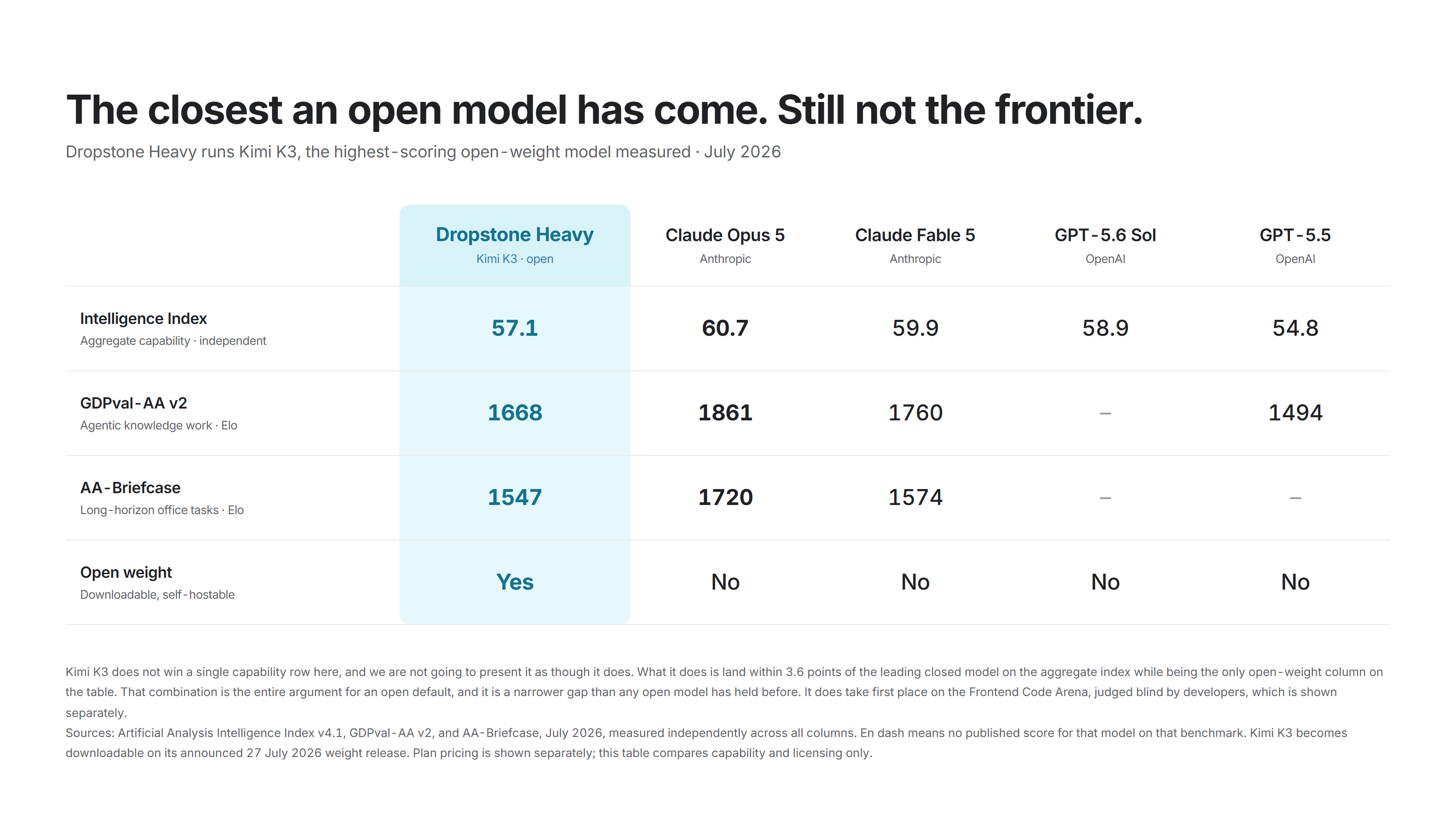
Heavy moves to Kimi K3 (2.8T MoE, 16 of 896 experts active, 1M context, native image input). Highest open-weight score on the independently measured AA Intelligence Index at 57.1, and the first open model to clear a flagship closed model (GPT-5.5, 54.8). Also first on the Frontend Code Arena at 1679, judged blind. Behind Claude Opus 5 by 3.6 points, shown honestly on the same axis.

Refresh cadenceOngoing

Heavy tracks the strongest open-weight model on independent measurement. The open-to-closed gap at the top narrowed from 8.8 points at 1.6 to 3.6 at 1.7; re-baselining is how that reaches you without a migration.

Benchmarks

Measured head-to-head.

Standard public coding benchmarks, latest published runs.

Dropstone Heavy 1.7 benchmarks
Overview

Everything Heavy ships with.

Dropstone Heavy is the tier for the hardest, longest-horizon work. At 1.7 it runs Moonshot's Kimi K3, a 2.8-trillion-param sparse Mixture-of-Experts model (16 of 896 experts active per token) with a 1M-token context and native image input. It scores 57.1 on the independently measured Artificial Analysis Intelligence Index, the highest of any open-weight model, and is the first open model to clear a flagship closed model, passing GPT-5.5 at 54.8. It does not catch the closed frontier: Claude Opus 5 at 60.7, Fable 5 at 59.9, and GPT-5.6 Sol at 58.9 all sit above it, and Opus 5 leads by a wider relative margin on long-horizon agentic measures (AA-Briefcase 1720 to 1547). The gap to the leader is 3.6 points, down from 8.8 one cycle ago, and we show both the gap and the narrowing on the same axis. On the Frontend Code Arena, judged blind by developers, K3 ranks first at 1679 across 1,757 votes, the first time an open model has led that board; Claude Opus 5 released after that ranking was published and is not scored on it yet. K3's own coding benchmarks run on Moonshot's harness, so we do not chart them; the independent index is the number we stand behind.

01

Long-horizon refactors

Changes that span many files and hundreds of steps. K3's 1M-token context holds intent across the run; on the longest autonomous sequences Claude Opus 5 still leads, and K3 is the strongest open option behind it.

02

Hard SWE-bench-shaped issues

Hand Heavy a failing test and a stack trace and let it read beyond the immediate file, edit, and re-run until green. K3 publishes no independently comparable coding-specific score this cycle (its vendor numbers run on Moonshot's harness), so the 57.1 index score is the measure we stand behind.

03

Frontend code, judged blind

K3 took six of seven Frontend Code Arena categories and ranks first overall at 1679, ahead of Claude Fable 5 and GPT-5.6 Sol. Claude Opus 5 is not scored on that board yet; first place is against the field as published.

Trust & safety

Security comes from the runtime, not the weights.

Read the full system card

The security boundary is the approval gate.

Every Dropstone request is treated as if the model could be adversarial. The CLI requires explicit user approval before any action that writes to disk, runs a shell command, or fetches a URL. No model output is ever auto-executed.

US-hosted inference. You control your data.

Heavy runs on SOC 2-certified, US-based inference providers. Enterprise and commercial data is never stored and never trained on, regardless of any setting. Consumer sessions help improve the open model we run and can be turned off anytime in settings, as text only, never your raw images.

Honest about what we cannot prove.

Heavy is built on Kimi K3, an open-weight foundation model. Goldwasser et al. (2022) proved no party can prove a closed foundation model is free of embedded behaviors, including Anthropic for Claude and OpenAI for GPT. We say this out loud. The runtime is why model origin does not matter for your code.

Pick your tier

Three tiers. One CLI.

Same approval gate, same US-hosted inference, same zero-retention guarantee across all three. Pick the smallest model that meets the task.

Dropstone Fast

Dropstone Fast 1.7

Low-latency agentic coding that is no longer just a latency tier. Built on DeepSeek V4 Flash 0731, hosted in the US.

Best for
  • Inline completion
  • File-scoped edits
  • Test scaffolding
Security
  • Approval gate on every tool call
  • US-hosted inference
  • Zero retention
  • Monthly model refresh
Dropstone Pro

Dropstone Pro 1.7

The everyday workhorse, and the most substantive change in 1.7: last cycle's Heavy tier is now the default on every plan. Built on GLM-5.2, hosted in the US.

Best for
  • Full-stack feature work
  • Frontend work, judged blind
  • Code review at scale
Security
  • Approval gate on every tool call
  • US-hosted inference
  • Zero retention
  • Monthly model refresh
You are here
Dropstone Heavy

Dropstone Heavy 1.7

The strongest open-weight model measured: first open model past a flagship closed model on the aggregate index, and #1 on the Frontend Code Arena. Built on Kimi K3, hosted in the US.

Best for
  • Long-horizon refactors
  • Hard SWE-bench-shaped issues
  • Frontend code, judged blind
Security
  • Approval gate on every tool call
  • US-hosted inference
  • Zero retention
  • Monthly model refresh

Fast and Pro are included on every plan, including free. Heavy is unlocked on the Pro plan ($20/mo) and Max plan (from $100/mo).

FAQ

Questions you'd ask in a security review.

When should I use Dropstone Heavy 1.7?
Dropstone Heavy is the tier for the hardest, longest-horizon work. At 1.7 it runs Moonshot's Kimi K3, a 2.8-trillion-param sparse Mixture-of-Experts model (16 of 896 experts active per token) with a 1M-token context and native image input. It scores 57.1 on the independently measured Artificial Analysis Intelligence Index, the highest of any open-weight model, and is the first open model to clear a flagship closed model, passing GPT-5.5 at 54.8. It does not catch the closed frontier: Claude Opus 5 at 60.7, Fable 5 at 59.9, and GPT-5.6 Sol at 58.9 all sit above it, and Opus 5 leads by a wider relative margin on long-horizon agentic measures (AA-Briefcase 1720 to 1547). The gap to the leader is 3.6 points, down from 8.8 one cycle ago, and we show both the gap and the narrowing on the same axis. On the Frontend Code Arena, judged blind by developers, K3 ranks first at 1679 across 1,757 votes, the first time an open model has led that board; Claude Opus 5 released after that ranking was published and is not scored on it yet. K3's own coding benchmarks run on Moonshot's harness, so we do not chart them; the independent index is the number we stand behind.
Is my code sent to a Chinese model provider?
No. Inference runs on SOC 2-certified, US-based providers. The model weights are open-source and loaded into those providers' US data centers. Your prompts never touch a foreign network.
What changes when Dropstone Heavy 1.7 gets refreshed?
The version number and benchmarks. The CLI surface, the pricing structure, the approval-gate behavior, and the security model do not change. Existing scripts and CI pipelines continue working without modification.
Do you offer enterprise deployment?
Yes. Dropstone Enterprise extends the same audited-tier platform with VPC, on-premises, and air-gapped deployments, SSO, audit logs, and custom SLAs. Pricing is seat plus usage at API rates, on annual commitments. Read the Enterprise plan overview or contact enterprise@blankline.org.

Ship with Dropstone Heavy 1.7.

Install the CLI, authenticate, and start running approval-gated agentic workflows. No credit card to start.